Saturday, 15 January 2011

More about Watchet crossings

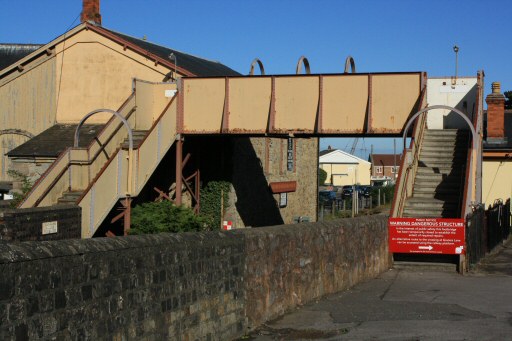
A report in the West Somerset Free Press suggests the owners of the footbridge at Watchet, the local district council, may have agreed to demolish the structure. It was the council who declared it unsafe and closed the bridge in 2009. The report goes on to suggest the council are to be asked to fund the demolition and the provision of a brand new footbridge. Well, that took a bit of time for that requirement to sink in, eh?

If the OK is given it seems the footbridge - dating from the 1880s will be taken down before trains start running again on 19 February but I guess there are later gaps in rail traffic for that work; and to procure from a specialist company in Wolverhampton a new footbridge made of modern materials but to a "heritage" style. Installation would have to wait until November when the trains stop running for a few weeks.


Meanwhile, just to the east, the issue of the gates at Govier's Lane Crossing continues to exercise minds. Late last year, a meeting was held at Watchet between local people and the Railway. Representatives from the Railway Inspectorate (who lay down guidelines and approve railway works such as Govier's Lane Crossing) also attended. Some of the discussions can be seen on Admiralscorner's channel on YouTube. The outcomes are yet to be announced but the gates have been officially chained open (to pedestrians) during the current "no trains" period. What happens from 19 February when trains restart for the 2011 season has yet to be seen.


In the other direction, the Railway have embarked on a major renovation exercise on the Mineral Line Bridge. This skew bridge spans the trackbed of the erstwhile West Somerset Mineral Railway, the trackbed now forming the popular Mineral Line Walk to Washford. As far as I can tell, the Mineral Line Bridge works have not generated local comment. Good.

Going back to the footbridge, it is said the new structure will look much like the existing one, Which is good as the heritage ambience of that part of Watchet will be unaffected. Or will the design require modification to allow wheelchairs, mobility scooters and pushchairs to cross, for the first time at this point, the Railway? There is sure to be an Equality Assessment. And will the Equality Assessment require ramps as well as steps? There seems to be room for ramps but at what detriment to the view on the road approach to the town from the south and to what extra cost to the council taxpayers?

The saga of the Watchet crossings seems likely to continue for some time yet...

Monday, 6 December 2010

So long CvdA

News reached me this morning of the passing on Sunday evening of Chris van den Arend. If the West Somerset Railway was one of a pair of gloves, then Chris was the other glove. Chris was a central player in the hard work which enabled the Railway to re-open in 1976 and later became Administrative Director in those early years. Latterly many will know Chris as Station Master at Williton and through his work with the Steam Trust, especially on the Sleeping Car. Chris also served as Chairman of the West Somerset Railway Association, for a time as the Railway's Operating Superintendent and was a long serving Signalman. Above all Chris was a really good friend to a great many people. The obvious memorials will be the Sleeping Car and the Williton Footbridge but many will know that Chris's legacy is, in fact, the entire Railway - and its community - which has prospered from his tireless, gentle, energy.

Friday, 5 November 2010

Crossing the Railway at Watchet

Not one but two. And both raising hackles with Watchet folk.

The Footbridge has now been closed for months due to being in need of repair. It is owned by the District Council who say they have enough money to demolish the Footbridge but no funds to repair and restore it so the Town Council was asked to find the money. The Town Council asked every household in Watchet to comment on raising the local tax to pay for the repairs. It seems most in Watchet preferred not to contribute. The matter continues. Meanwhile most people wishing to cross the Railway now tramp along the Platform at Watchet Station to the other crossing at Govier's Lane.

Now, the Govier's Lane Crossing, with the footpath traversing several tracks and sidings, has been a problem for Watchet folk since the Railway was opened in 1862 right through to the closure in 1971. With the reopening in 1976 the Crossing was
provided with small red/green lights indicating to pedestrians if a train was due on the sole remaining railway line. Small gates were also provided. Over the years the gates were "lost". Recently the West Somerset Railway upgraded the Crossing to national standards. The small lights were taken away, the approach fencing modified and the gates returned. It is the awkwardness of the gates that seems to be the main focus of complaint from users of the Crossing. Certainly it is not easy for wheelchair users to open the gates. And the gates tend to clatter when closing despite the Railway fixing dampers.

I guess if a bridge was built to modern standards at Govier's Lane Crossing then many of the problems would go away at that particular place. But of course a new modern bridge, complete with long sloping ramps, would cost a fortune and I'm sure a bid for funds would not be successful unless bundled with other nearby developments which themselves seem to have stalled.

As for the old Footbridge, its days may well be numbered. Upon its demise, there remains the little matter of getting to Govier's Lane Crossing. The use of the Platform may be the obvious route but as a thoroughfare it is hardly safe and much less so when packed with waiting passengers. And when a train stops it is complete chaos.

Much to ponder for some. Much to watch with interest from afar.

Monday, 1 November 2010

Stones again

Great news that the Railway will be used by up to 17 trains bringing a total of around 7000 tonnes of stone boulders from the Mendips to Minehead. The stone is for sea defence work at the Dunster end of the Golf Course.

Trains will run early morning, as required, to Minehead, where the loco will run round its train and haul it back to Drift Crossing where the stone will be unloaded and later taken across the fields to the worksite on the coast. The empties will then head back to Westbury leaving the WSR at lunchtime.

What a marvellous example of a railway doing what a railway should do. And well done the WSR for negotiating the deal.

So that's the fourth contract for stone traffic now. Plus the ongoing spent ballast trains calling at the Norton Triangle worksite.

It makes you wonder what other freight could be carried on the Railway. Do Tesco or Morrisons get their stores deliveries by train elsewhere; or what about the timber from the nearby forestry works?


Wednesday, 31 March 2010

Train travel and the new wheelchair policy

When holidaying in the area our family often use the West Somerset Railway as part of a day out.

This year, for the first time, we were subjected to the WSR's new wheelchair policy.

We had already contacted the Railway to allow them to assess the wheelchair used by our son, Matt. The length of the wheelchair, in its normal travelling position, exceeds the maximum dimensions allowed under the newly introduced policy. Despite being around 170mm too long, they granted a three year permit-to-travel to my son. The conditions of the permission require a named carer to accompany Matt. The carer is also responsible for moving the chair at all times when on the Railway. Other conditions require a phone call to the Railway to ensure Matt can be carried on the chosen day and train.

Anyway. One rainy morning, a train trip seemed a good way of getting out of the house so we decided Matt and his Mum would make a single journey from Dunster to Bishops Lydeard. We duly rang the Railway and during a very pleasant conversation we were advised to speak to the Dunster Station staff who would show us where the brake van would stop so help speed the loading of the wheelchair. The man on the phone did not quiz us about the size of the wheelchair or ask if we had a permit, and he cheerily concluded with "We look forward to seeing you"

The Dunster staff were very helpful, as were the train staff and before long the train had arrived, everyone safely boarded, and the train was on its way. On board, Matt and his Mum joined two other wheelchair users and their carers, all making for Bishops Lydeard. Whilst we knew what the fare would be, the ticket inspector was not quite so sure, maybe the new policy had confuse him.

Now the brake van had three wheelchairs and things were a bit tight. Not helped by the two large bikes propped against the carriage wall and taking up as much space as a wheelchair. Not only were the bikes not strapped to the coach and therefore able to topple and injure someone quite unable to move quickly out of the way, but it seems there is no policy on the size of bikes nor on the safe carriage of bikes. So non-essential bikes are welcome without question; essential wheelchairs are subject to all manner of question, approval, pre-planned arrangements, provision of attendant carer and so on.

We planned a second train trip. It was to be an afternoon trip for all three of us. However, as most people find on the morning of the day, the weather looked better in the morning with rain promised for the afternoon. So we revised our plans. Good job we had not made elaborate arrangements with the Railway Company. Again, we phoned the Railway. We want to take the wheelchair from Watchet to Washford on the 11.59am from Watchet. This time the Railway man was not so sure whether we could go or not. "It's a Gala day" he said but did not explain how a "Gala day" would affect our plans.

As an afterthought, he asked if the wheelchair was "big". In our opinion it is not a big chair so we said "no". That answer was seemingly accepted. We were not asked if we had a permit.

We parked near Washford Station and enjoyed the Mineral Line Walk to Watchet. At Watchet Station we asked at the booking office for our tickets to Washford. There was a little confusion about the fares for wheelchair users and carers. but with a little help from us it was resolved. We were advised the Railway had brought in a new wheelchair policy and the Station staff had a brief discussion about whether Matt's chair was oversize or not. We broke into the conversation and said it was but it had been assessed by the Railway and that a permit had been issued. The Station staff then went on to tell us the reasons for bringing in the new policy, although we did not understand why the reasons applied to Matt.

It's fair to say the Station staff were very friendly and helpful although perhaps a little embarassed when dealing with the new policy and trying to explain why it was introduced. We were shown where to wait for the train and heard more about heavy wheelchairs and crushed toes of Station staff.

The brake van was packed. With standing passengers. It was a busy train. There were a couple of seats, occupied by "normal" passengers, who stayed put. Matt was unable to get to a window and spent the mercifully short journey to Washford surrounded by standing passengers.

The train staff were excellent and helped as much as they could in the circumstances.

So, how did the new wheelchair policy affect our trips? On the positive side, despite having a wheelchair that falls foul of the policy, we were able to travel. On the negative, the requirement to phone seemed pointless because the situation on the trains was not known to the guy on the phone who was therefore not able to give quality advice about space in the brake van.

Lots of mixed messages. Lots of confusion. Lots of embarassment on both sides.

Finally. The notices on blue A4 paper posted at Minehead bluntly suggest wheelchairs exceeding the maximum dimensions will not be carried. Our trips prove the blue notice statement is incorrect. And had we simply arrived at the Station, like many do, and then read the notice, we could so easily have turned away, feeling unwelcome, and not spent money on tickets and in the shops and cafes. And not have enjoyed a trip on a steam train. We'd advise the Railway to revise the wording on those blue notices.
Tuesday, 16 February 2010

Wheelchair users could be denied travel on West Somerset Railway

The WSR has introduced new policy for disabled visitors. It contains useful advice about which station facilities are suitable or not. It seems the "disabled", if they can show they are indeed "disabled", can get half fare travel, and their carer likewise. I'm not quite sure who on the WSR staff determines whether a visitor is "disabled" and who is a "carer". Personally, I think it would be better for the Railway to charge full fare and use the extra revenue to invest in better facilities on the trains and stations for those who find the present arrangement wanting. To be fair, the WSR has and is investing in better facilities. A little more cash might speed that work.

Now, the new policy has a particular fault which visitors using wheelchairs and motorised scooters do need to pay attention to. The policy lays down maximum dimensions on the trains for wheelchairs and motorised scooters - 1200mm long, 700mm wide, 1350mm high, 1200mm from floor to lap, 150mm from floor to top of shoe. The WSR have adopted the dimensions from UK and EU regulations for accommodating wheelchairs in new-build trains and other railway facilities. The regs do not apply to heritage railways. Furthermore, my research finds the regulations were based on the results of a consultation exercise which measured lots of wheelchairs but which failed to deliberately include a good representation of all users especially long-term wheelchair-bound adults, many of which cannot use the "reference wheelchair" as now specified in the regulations. So, we have a UK and EU regulation based on a flawed consultation exercise and now adopted by a heritage railway who, despite having their attention drawn, seem to want to ignore the faults and the inappropriateness of the regulations to their business.

The WSR say those who use "oversize" wheelchairs can ask for an "assessment" which, if successful, may allow them to travel. I have no idea, and the WSR have declined to explain, what processes the "assessment" uses, who carries it out, where it is carried out and when. I suspect the WSR have not even thought about it, yet.

The result is many wheelchair-users, perhaps including some regular WSR visitors, will find themselves barred from travelling on this heritage railway.

I know one wheelchair-bound user who has used the WSR trains since 1977 with no problem, incident or complaint (from either side) and who now find his wheelchair exceeds the maximum dimension by a few centimetres and technically cannot be carried. And that despite no change to the Railway infrastructure, no change to the ramps used to get the wheelchair on and off the train, no change to the accommodation inside the train. Nothing has changed. Except the rules. To me, that sounds like discrimination and could be challenged in court if someone felt so inclined.

Many representations have been made to the Railway asking for a rethink but it is clear from their replies that they have no intention of changing the maximum dimensions.

Like many folk who have a wheelchair-bound member of the family I remain positive and optimistic that one day the WSR will see the light and modify the policy to enable almost all wheelchair users to travel on the best heritage railway in the land.


Wednesday, 13 January 2010

A Facebook Group

"I travelled on the West Somerset Railway in 2010" is a Facebook group for those who plan to travel on Britain's longest heritage railway in 2010. Hopefully a ticket will be purchased! It would be nice to see a large membership of the group on Facebook and even better if many members can make at least one trip this year and help the Railway reach a record 250000 passengers in 2010. I suppose the key to success is to ensure many Facebook users join up. I'm not sure how that is done effectively but I'm sure every effort will be made. There are ten stations - Bishops Lydeard, Crowcombe Heathfield, Stogumber, Williton, Doniford, Watchet, Washford, Blue Anchor, Dunster and Minehead. And lots to superb scenery along the twenty mile steam powered railway which runs from the Vale of Taunton Deane, through the gap between the Quantock Hills and the Brendon Hills, to the Bristol Channel coast at Watchet, Blue Anchor and Minehead, the gateway to Exmoor. See www.wsr.org.uk for more details.